
Whether you are a seasoned (ha-see what I did there?) pro, or a beginner in the kitchen, salt is one of those ingredients we use instinctively-almost without thinking. But the truth is, not all salt is created equal. And once you understand the differences, it becomes clear just how much your choice of salt can affect the outcome of your final dish.

The importance of salt in cooking and baking can be overlooked at times. In my humble opinion, proper use of salt is a foundational linchpin to hang all good cooking on. After years of recipe testing, countless baches of pizza dough, dry-brined roasts, and late night kitchen experiments, I have discovered that it really does begin at this foundational level. Fancy techniques and unique ingredients, while fun to experiment with, serve as no replacement to the proper use of salt in all facets of cooking and baking. My hope is that this guide will help shed some light on the matter, and overall, make you a better cook!
Jump to:
A Pinch of Science to Start - What exactly is salt?
Salt is the common name for the mineral sodium chloride, and it plays an extremely important role in cooking and baking. It serves as a flavor enhancer to make things taste more like themselves (beef tastes "beefier," cheese tastes "cheesier," etc.) without imparting much of its own flavor.
On a molecular level, all salts are the same thing: sodium chloride (NaCL). The differences between salt varieties mostly stem from their physical characteristics (crystal shape, structure, and size; additional mineral compounds; color; etc.) The largest impact of the final product comes from how the salt is harvested and processed. Geographical regions can also play a small part.
Since salt is a mineral, it can't be classified as "organic." If you see "organic" on a salt label, it usually means that the product either contains no additives or uses additivest that are organic-certified. The best way to know exactly what's in your salt is to check the ingredient list. Personally, I try to avoid any extra additives whenever possible.
Know Your Salt: A Shakedown of the Essentials
The main types of salt that you will encounter in cooking are kosher salt, sea salt, and table salt. Each have their own properties and can have drastic impacts on how you cook. First, let's explore what they are, then we will delve into how to use them, and how to choose the right one for your particular culinary scenario. Pickling salt is another type of culinary salt, however that is a completely separate topic. For now, we'll just be discussing the basics.

Kosher Salt - The MVP of the Kitchen
Kosher salt is an extremely versatile salt that has a flat or even hollow crystal structure with a fairly coarse grain size. It's prized by chefs and home-cooks alike and is particularly good for seasoning cuts of meat, as well as most dishes before, during, and after cooking. If I were to only have one type of salt in my kitchen, it would 100% be kosher salt.
The name comes from the traditional Jewish practice of purifying meat by using salt to draw blood out of the protein. The larger, irregular crystal structure makes it easy to pick up with your fingers and spread evenly over large cuts of meat, it dissolves relatively quickly, which is what helps it stick to protein and not just bounce off. This also makes this type of salt ideal for dry-brining, which is something we'll get into later.
Kosher salt typically doesn't contain any additives and is usually harvested from inland salt deposits. Some brands - like Jacobsen Salt Co. - harvest their salt from seawater and use evaporative methods to process their salts. They are based out of Netarts Bay, Oregon, and use a proprietary drying process that results in really fantastic salts. They offer a myriad of salt products that are truly second to none. Check out their kosher salt here. (Full transparency - I am not directly affiliated with Jacobsen Salt Co. in any way. - I just really like their products, so go check them out!)
Battle of the Brands: Why Kosher Salt Isn't One-Size-Fits-All
The two major brands of Kosher salt you will find on the market are Diamond Crystal and Morton's, each with their own loyal following. Most, if not all, of my recipes are developed using Diamond Crystal kosher salt, unless stated otherwise.
Here are several of the differences that you should be aware of: Morton's processes their salt by compressing the salt crystals together into flat flakes, which makes it more dense than Diamond Crystal kosher salt. One teaspoon of Morton's salt will contain more salt than Diamond Crystal, and you cannot substitute them 1 for 1. Morton's also includes "Yellow Prussiate of Soda", which is a food-grade anti-caking agent.
I prefer Diamond Crystal over Morton's because it's easy to use doesn't have any additives, and is consistent. I also found myself oversalting things when using Morton's since it's more dense and it takes longer to dissolve into dishes. Overall, I just think Diamond Crystal is a better product.
Getting the Most From Kosher Salt
Kosher salt is fantastic all around salt to use in all aspects of cooking. As noted above, if I were to have only one type of salt in the kitchen, it would be Kosher salt. The larger crystal structure is perfect for seasoning cuts of meat prior to cooking (more info on this in the Dry Brining section below!), it also dissolves quickly in liquids which makes tasting and adjusting salt levels super easy as you don't have to wait long for the salt to dissolve. It's also great as a finishing salt to sprinkle a little on top of a dish right before serving - although it's not quite as fancy looking as a dedicated flaky finishing salt, it functions the same.
Kosher salt can also be used in baking, but I would only do so when weighing the ingredients (unless the recipe specifically calls for Kosher salt). Most baking recipes use table salt, or fine sea salt by default. Both of those dissolve quickly and are easy to disperse through doughs and batters. For example I've used Morton's kosher salt in pizza dough, and I could see the denser salt flakes dropping to the bottom of the mixing bowl before they were able to be incorporated into the dough.
If you were to use kosher salt as a one-to-one substitute with volume measurements in baking, you would end up with an under-seasoned dish since the kosher salt isn't as dense as table or fine sea salt. Weighing ingredients avoids this problem all together as 1 gram of kosher salt is the exact same as 1 gram of table or fine sea salt (or any other salt variety for that matter).
Sea Salt, Three Ways: Fine, Coarse, and Flaky
Sea salt comes from the sea (as its name suggests, thankfully). Typically, sea salt is minimally processed and has a more dense crystal structure than Kosher salt. Sea salt is usually made by collecting sea water, and then filtering and boiling until all that remains is the salt itself. A few notable types of sea salt are Fleur de Sel, Sel Gris (or gray salt), Maldon Sea Salt Flakes, Redmond Real Salt - Fine Sea Salt, and Celtic Sea Salt.
The term "sea salt" is a bit of a catch-all and can be slightly misleading as the definition is not regulated. Products labeled "sea salt" can vary widely in appearance and texture from one brand to another. Typically, sea salt will fall into one of three categories: fine sea salt, coarse sea salt, or flaky sea salt. Case-in-point, pictured below are Redmond's Real Salt - Ancient Fine Sea Salt, Morton's Coarse Sea Salt, and Maldon Flaky Sea Salt.
Another example that shines the light on how the term sea salt can cause some confusion is from Redmond's Real Salt brand. Their salt is labeled as sea salt, however all of their products are mined from a salt deposit in Utah. By calling it "ancient sea salt", they are technically correct since the salt deposit they use is from a seabed that has long ago dried up. While this may nag at some people's conscience, that's not for me to decide (luckily enough!).

Notice the not-so-subtle difference in the salt crystal structure between all three examples here:
- Fine Sea Salt - Has a smaller more uniform structure, and acts more like table salt. This is a good variety to use for baking since it dissolves quickly and is easy incorporate into doughs.
- Coarse Sea Salt - Has a larger, more dense structure and can generally be used like kosher salt. Word of caution though - since it's more dense than kosher salt, it's important to taste your dish as you are cooking it to avoid over-salting.
- Flaky Sea Salt - Flaky salt is typically used as a "finishing salt". This salt is great for sprinkling over finished dishes to add the final pop of salt, and to add a bit of texture/crunch as well as visual appeal. As you can see, these crystals are huge, as such, they do a great job of sticking to the top of finished dishes.
Use It Right: Sea Salt by Texture and Task
Each type of sea salt will have its own use-case based on their physical characteristics.
- Fine Sea Salt - Great for baking due to the uniform and small crystal size. This is a good substitute for table salt and generally what I use in all of my baking recipes. I recommend Redmond Real Salt - Fine Sea Salt.
- Coarse Sea Salt - As the name suggests, this is a bit more coarse than fine sea salt, and can generally be used in place of kosher salt. It is, however, slightly more dense than kosher salt, so take care and add it gradually. Taste as you go to avoid over-salting - you can always add more!
- Flaky Sea Salt - These are large, flaky crystals which are typically used as a "finishing salt". Finishing salt simply means that you add it to the dish right before serving - sprinkled over sliced steak or chicken breasts, on crispy oven roasted potatoes, etc. This adds a final pop of salt, and a bit of crunchy texture that can really elevate a dish. The only time I wouldn't use a finishing salt would be in a soup, stew, or other "wet" dish. The most famous of flaky/finishing salts is Maldon Sea Salt Flakes.
Table Salt: The Old Reliable (With Some Baggage)
Last, but not least is humble table salt. This is likely the first thing that comes to mind for the average person when salt is mentioned, however this is the type that I use the least. This type is the most processed and refined variety and is the most likely to contain additives (weather it be iodine, or anti-caking agents, etc.). Iodine additives are a carry-over from almost a century ago where it was thought that most people suffered from iodine deficiency. That's not so much the case these days.

Table salt has the most uniform structure and is very dense. The smaller crystal size has a more difficult time sticking to meat as it tends to bounce off when sprinkled on, and likes to collect in cracks and crevices.
The smaller crystal size also means that you can physically fit more salt in one teaspoon than you can of other varieties, like kosher or sea salt. As such, you cannot use table salt as a direct replacement for other varieties since a little bit goes a long way. I feel that the best use for this is exactly as the name suggests - at the table to adjust salt levels to your or your guests personal tastes.
How to Use Table Salt
The small, uniform crystal structure of table salt make it a great candidate for baking recipes that call for precise measurements. It dissolves quickly and is easy to evenly incorporate into doughs and batters. As mentioned above it also works well at the table to quickly adjust salt levels to personal preference.
Timing Matters - When to Add Salt
Almost as critical as the type of salt you use, is when you decide to add it. For instance, if you added all of the salt that a recipe calls for at the very end of cooking, you would technically have a properly seasoned dish, however it would more than likely have an overly salty taste.
To combat this, what I like to do is to add salt throughout the whole cooking process. Author of the famed cookbook and Netflix Series, "Salt, Fat, Acid, Heat: Mastering the Elements of Good Cooking", Samin Nosrat includes a concept of "seasoning from within".
This is simply adding salt during the whole cooking process, and tasting your way as you go - for example adding copious amounts of salt to water for pasta, adding a pinch or two of salt when sauteing onions/vegetables to help coax the liquid out to achieve better browning, or salting meats a day (or two) ahead of time to allow it to dry brine. Speaking of dry brining - the next section below is all about what it is and why it's so important.
Rub It In: Why Dry Brining Works
If you are familiar with my recipes (especially ones with large cuts of meat), you'll note that I am a huge proponent of the dry brining technique. This is simply a matter of adding salt to cuts of meat well ahead of cooking them, and resting them uncovered in the fridge.
The combination of salt and time draws moisture out of the meat, that then dissolves the salt, which is then re-absorbed by the protein when given enough time. The absorbed salt does two things, it seasons the meat more deeply, and it partially breaks down the muscle fibers so that they don't contract as much during cooking. This in turn, retains more moisture in the final dish, yielding more tender and juicy results.
Another benefit of this process is that after the salt mixture is re-absorbed by the protein, the outer layer begins to dry out. The drier the surface of your protein, the better the browning will be. This is due to the fact that you no longer have to cook off any of the extra moisture, so things begin to brown much more rapidly.
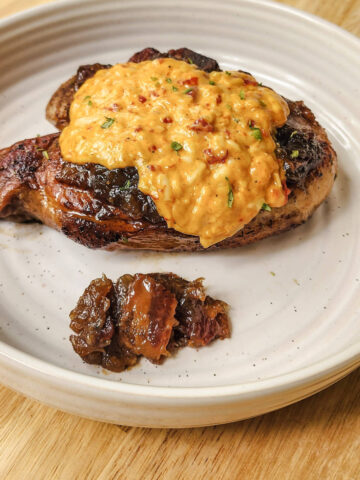
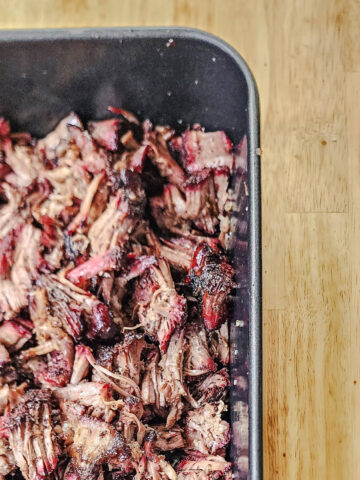
A few of my recipes that feature this technique are show below:


Dry Brine 101: The Bare-Bones How-To
While there is a bit of technique (and math *gasp*) to dry brining, it really is as simple as applying salt to a cut of meat and allowing it to rest for a certain amount of time. While this section is not an all-encompassing article, my aim is to give you the basic tools and know-how on how to tackle this on your own. The two key components are Salt, and Time.
Quick Tip: This technique is not ideal for any sort of ground meat. While it still works the same way, the ground meat will breakdown too much and you will end up with something closer to sausage than a hamburger.
Salt
The basic rule of thumb is to use approximately ½ to ¾ of a teaspoon of kosher salt per pound of meat. The type and brand kosher salt matter, as they are not all created equally (more on that above). The general rule that I like to follow is if using Diamond Crystal, use ¾ of a teaspoon per pound, and if using Morton's use ½ a teaspoon per pound. Simply calculate the amount of salt you need by multiplying the pounds of meat by either 0.5 or 0.75 and that gives you the total amount of teaspoons to use.
Once you have your amount of salt, place your protein on a wire rack-lined baking sheet, then evenly cover with the salt on all sides. Then place the whole thing uncovered in the refrigerator for the allotted time. Once you do this enough, you will likely get a feel for what is the proper amount of salt to use.

Time
The second component with dry brining is time. For thinner cuts of meat like steaks, pork chops, etc. allow for at least 45 minutes of resting time, up to overnight. Larger proteins like whole chickens, turkeys, chuck roasts, pork roasts, etc. will need to be rested at least overnight, or up to 2 days in advance. The general rule is that everything, regardless of what kind of meat/protein, etc. is ready when the surface has sufficiently dried out and has not become leathery or tough.
Take This With A Grain of Salt
Salt is so much more than just a basic seasoning - it's one of the most important ingredients in any recipe, whether you're baking, grilling, dry brining, or finishing a dish. Understanding the differences between kosher salt, sea salt, and table salt (and when to use each) can completely transform your cooking and baking results. Hopefully, this salt guide helps you season with confidence and take your home cooking to the next level - one pinch at a time.
Comments
No Comments