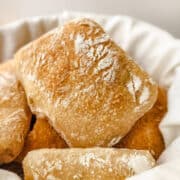
Homemade Ciabatta Rolls
These Homemade Ciabatta Rolls are pillowy-soft on the inside and light and crusty on the outside. Perfect for sandwiches or with soups!
Servings: 8 Rolls
Calories: 355kcal
Equipment
- Instant Read Digital Thermometer Optional
- Parchment Paper
- Pizza or Baking Steel Optional
- Pizza Peel Only needed if using a pizza or baking steel
Ingredients
- 2 ¾ Cups + 2 Tablespoons Bread Flour
- ¼ Cup +2 Teaspoons Whole Wheat Flour
- 1 ⅓ Cups Water Warmed to 90 - 100°F, Divided
- 2 ½ Teaspoons Fine Sea Salt
- 1 Tablespoon Olive Oil
- 2 ½ Teaspoons Active Dry Yeast Substitute equal amounts instant yeast
- 1 Small Pinch Sugar Omit if using Instant Yeast
Instructions
Mixing
- Add 75% of the warm water (270g - about 1 ¼ cup) with both flours, salt, and oil. Knead the dough on medium-low speed for 2 to 3 minutes until a dough ball forms and pulls away from the sides of the bowl.
- Cover and let rest for 30 minutes to 1 hour. (This rest is called an autolyse, and it allows the proteins that form gluten to hydrate and unwind, which makes it easier to develop gluten much more readily—a much-needed component to this recipe!)
- In the last 5 to 10 minutes of the autolyse, ensure that the remaining 25% of water (90g or ⅜ cup) is still heated to 100 °F. Remove from the heat, add the yeast and a small pinch of sugar and allow the mixture to bloom for 5 to 10 minutes. (The sugar is not needed if using Instant Yeast instead of Active Dry Yeast).
- Add in the yeast mixture to the dough a little bit at a time while mixing on medium-low until evenly combined and a smooth dough forms, about 7 minutes.
Stretch and Folds & Bulk Proofing
- Transfer the dough to an ungreased bowl and cover. Rest for 30 minutes.
- Perform three sets of "stretch and folds." To do this, wet your fingers, grab one edge of the dough, and fold it over itself. Repeat with the three remaining sides of the dough. (There is a brief video in the blog post above for reference.)
- Repeat the 30-minute rest, and stretch and fold two more times.
- After the last stretch and fold, cover and allow to bulk proof on the counter for 1 to 1 ½ hours until doubled in size. Cover and transfer to the refrigerator, and cold ferment overnight.
Shaping, 2nd Proofing & Baking
- Heavily dust a work surface with flour to ensure the dough doesn't stick. Remove the dough from the refrigerator, and gently turn the dough out onto the floured work surface.
- Gently stretch the dough into a rough 8 by 11-inch rectangle, and generously dust the top of the dough with flour.
- Using a sharp knife or a bench scraper, divide the dough into 8 to 10 even pieces. (Now is the time to decide how big you want to make the rolls.)
- Pick up the rolls, flip them over, and transfer them to a parchment paper-lined baking sheet or pizza peel (if using baking steel or stone).
- Cover lightly and allow to proof for a second time for 1 to 2 hours (2 hours is preferred as it will give you larger air pockets).
- During the last hour of the second proof, preheat the oven to 450°F (including the baking steel if using.)
- Immediately before baking, fill a 9 x 13-inch casserole dish ⅔ with boiling water and place it on the bottom rack of the oven. (This creates steam in the oven, which helps develop a crispier crust on the bread. This step is optional.)
- Transfer the rolls and parchment paper to the baking steel with the pizza peel, or place the baking sheet in the oven and bake for 20 minutes.
- Remove the rolls from the oven and cool on a wire cooling rack completely before serving.
Notes
Storing Tips
These Homemade Ciabatta Rolls are best eaten fresh, as is the case with most homemade breads. If you have any leftovers, store them in an airtight container at room temperature for 2 to 3 days. Any time beyond that, transfer them to the fridge for about a week.
These also freeze very well. Wrap each roll tightly in aluminum foil or plastic wrap, then freeze in a gallon-sized zip-lock bag. To thaw, set them on the counter for a few hours, until soft.
Reheating Tips
To reheat the rolls, the best method is to sprinkle them with a little bit of water, wrap tightly in aluminum foil, and heat them in a 350°F oven for about 4 to 7 minutes. Optionally, you can wrap them in a damp paper towel and microwave them for 30 seconds at a time until they reach your desired temperature. I recommend using the oven method if possible, since it provides better results.
Nutrition
Calories: 355kcal | Carbohydrates: 68g | Protein: 12g | Fat: 3g | Saturated Fat: 0.5g | Polyunsaturated Fat: 1g | Monounsaturated Fat: 1g | Sodium: 731mg | Potassium: 126mg | Fiber: 3g | Sugar: 0.4g | Vitamin A: 2IU | Vitamin C: 0.003mg | Calcium: 18mg | Iron: 1mg
